
Yucaipa City Directory Collections by Year
The verified historical lead comes from the National Archives and Records Administration. NARA's circa-1930 inventory identifies San Bernardino directories that include Mentone, Crafton, Loma Linda, Bryn Mawr, and Yucaipa Valley. It lists 1927, 1929, 1931, and 1933. The inventory does not name a publisher, so a title page should be inspected before attributing the book to a commercial publisher. The locality note is the important discovery detail: Yucaipa may be inside a regional volume rather than on the cover.
| Collection | Verified span | Where held | Access and use |
|---|---|---|---|
| San Bernardino regional volume | 1927, 1929, 1931, 1933 | NARA-listed circa-1930 holdings | Inspect catalog, volume title, and image availability |
| California city and county directory collection | Statewide collection; Yucaipa volume needs catalog check | California State Library, California History Section | Request a specific volume or reference search |
| Yucaipa Branch local-history materials | Exact directory years not published online | San Bernardino County Library, Yucaipa Branch | Ask for telephone, reverse, yearbook, and newspaper holdings |
| Federal census schedules | 1850 through 1950 public as of 2026 | NARA and library genealogy databases | Pair the 1930 and 1950 snapshots with directory years |
| Newspapers and local collections | Title and year dependent | Libraries, archives, and historical society | Use obituaries, notices, and social columns as leads |
The table shows why a missing year does not end a family-history search. A directory may have been published but not cataloged under Yucaipa, held at a different library, or omitted from a crawlable page. Ask a reference desk to search San Bernardino, Yucaipa Valley, Crafton, and neighboring locality terms together.
Why Yucaipa Appears Under Yucaipa Valley
The regional title is a useful Yucaipa records quirk. In the late 1920s and early 1930s, a San Bernardino city directory could carry Yucaipa Valley as a locality inside a wider county volume. A title search for “Yucaipa city directory” can therefore miss the relevant item even when the volume has a Yucaipa section. Search the locality line in NARA's directory inventory and ask catalogs for San Bernardino regional editions.
That naming pattern also fits the area's record history. Yucaipa incorporated on November 27, 1989. Earlier deeds, assessments, courts, and permits were county-centered, while directories and census schedules could use valley, rural-route, or neighboring-community labels. Keep both the historic label and modern city name in a research note. A dated locality phrase is evidence about cataloging, not a claim that a person lived inside today's exact city limits.
NARA's city-directory inventory is the source for the four regional years and the Yucaipa Valley locality note.
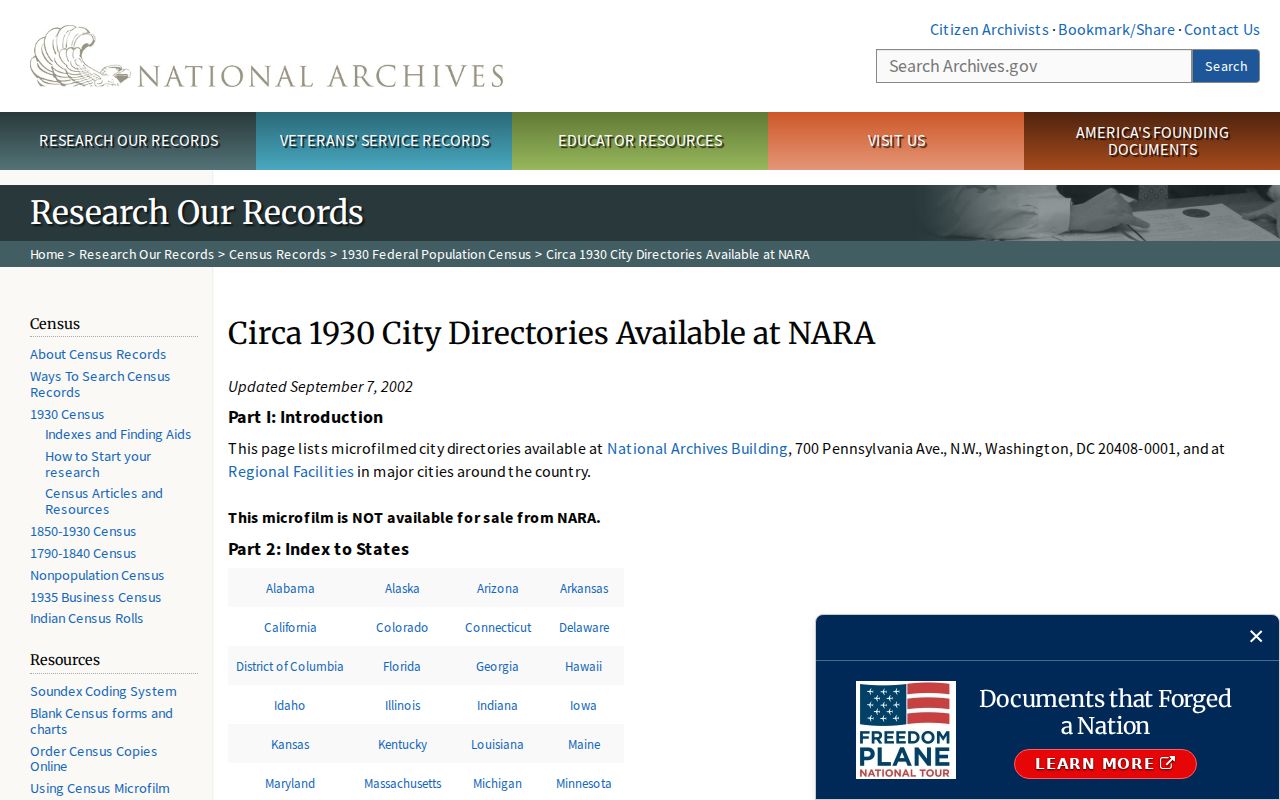
The NARA image captures the catalog clue that makes the regional collection discoverable. The locality line matters as much as the volume title.
Reading a Yucaipa Directory Entry
A Yucaipa directory entry should be transcribed as a dated record, not paraphrased from memory. The name may use an initial or a married surname. A spouse may appear in parentheses. An occupation, employer, business address, telephone, or residence marker can add context. The volume's front matter controls the abbreviations. Do not assume that a small letter has the same meaning in every publisher's volume.
| Name | Surname, given name, and initials; compare spelling and surname order. |
|---|---|
| Spouse or widow mark | May place a relationship or a death clue beside the main entry. |
| Occupation or business | A dated role or employer clue, not proof of residence or continuous work. |
| Street address | House number, street, residence marker, or business location as printed. |
| Telephone | Present only in some volumes; treat it as a period contact clue. |
| Owner or residence symbol | Use only when that volume's abbreviation key defines the symbol. |
- Criss-cross section
- The street-order half of a directory when the volume includes one, used to read addresses rather than surnames.
- Householder index
- An index organized around heads of household or address holders, with scope set by the particular volume.
- Abbreviation key
- The publisher's legend, usually in the front matter, that explains residence, widow, business, and other marks.
Yucaipa Library's Local History Desk
The Yucaipa Branch of the San Bernardino County Library is a practical first stop when a catalog record does not answer the year question. The branch is at 12040 Fifth Street, Yucaipa, CA 92399, with phone 909-918-2380 and email ycpref@lib.sbcounty.gov. Published hours are Monday through Wednesday 11 to 7, Thursday and Friday 10 to 6, Saturday 9 to 5, and Sunday closed. Verify hours before travel.
Ask the reference desk to check San Bernardino telephone books, reverse or criss-cross directories, Yucaipa High School yearbooks, Yucaipa and Calimesa newspapers, obituary clipping files, Ancestry Library Edition or HeritageQuest access, subdivision maps, and works by the Yucaipa Valley Historical Society. Exact branch-held directory years were not published in a stable online finding, so a direct catalog or reference question is more reliable than assuming the shelf is complete.
The official Yucaipa Branch page supplies the branch contact and hours.
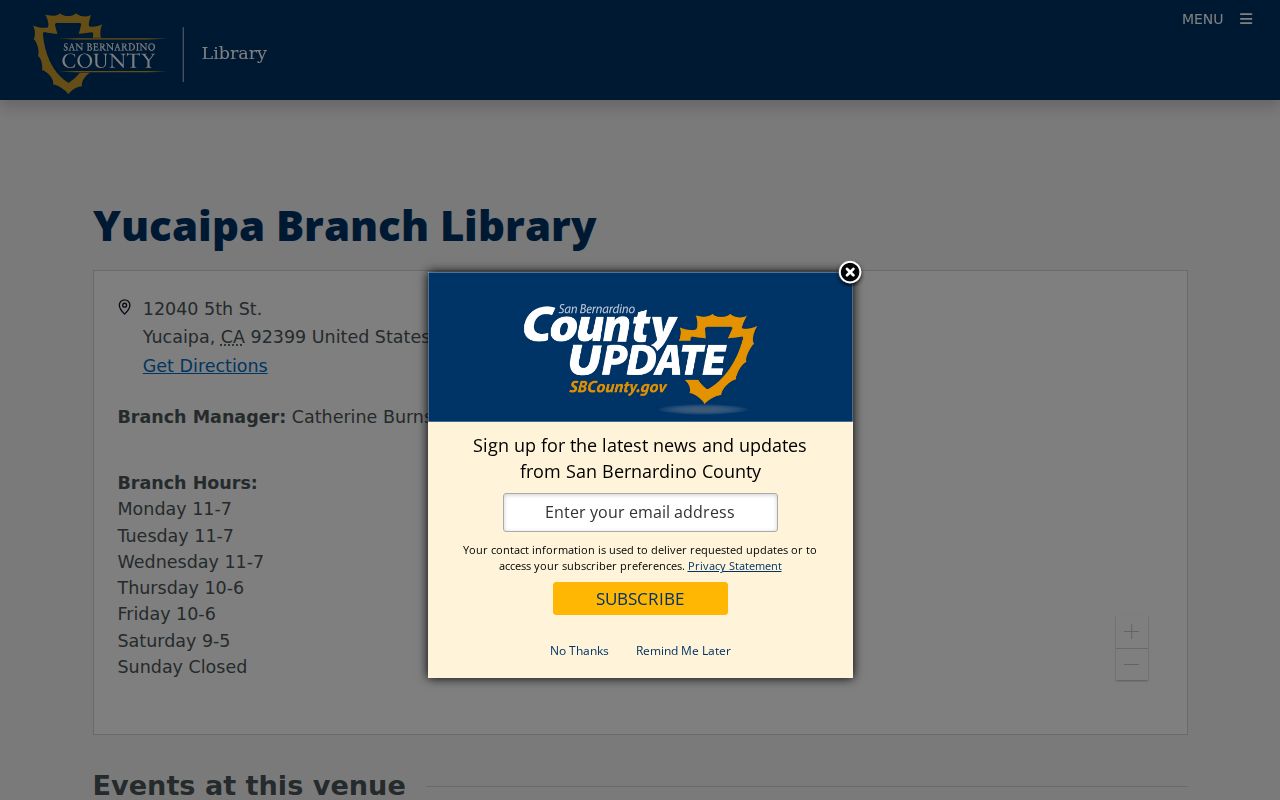
The library image marks the physical reference route for a Yucaipa historical search. Call ahead with a surname, address, approximate year, and requested record type.
Yucaipa Historical Society and Local Memory
The Mousley Museum of Yucaipa History and the Yucaipa Valley Historical Society add material that a printed volume cannot supply. The museum is at 35308 Panorama Drive. Research notes list 909-790-4685, visits by appointment, and free first-Saturday programs with doors at 1 p.m. and the program at 1:30 p.m. Ask about surname files, oral histories, historic photographs, school material, ranch or tract histories, business ephemera, and whether copying or research fees apply.
Local memory is strongest when the inquiry is specific. Give the curator a surname, approximate years, address or tract, occupation or school, and desired record type. A museum may know a photograph or collection exists without holding a searchable resident index. Treat an oral-history lead as a path to the original item and record the date, speaker, and collection name in the research note.
The Mousley Museum and historical society site is the source for the local contact route.
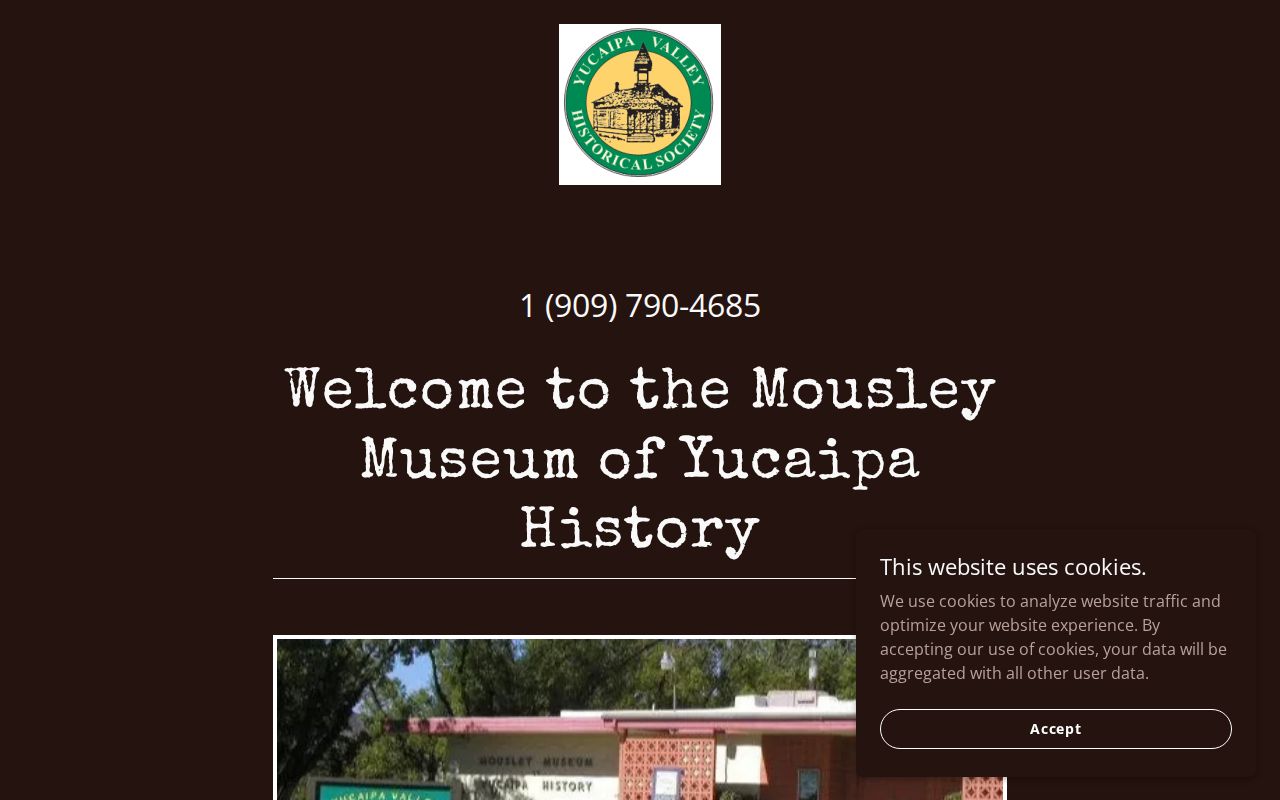
The museum image belongs beside the directory shelf because photographs, oral histories, and business papers can explain why a name disappears from one volume year.
Yucaipa Directory Timeline and Record Gaps
Yucaipa's record trail has staggered starting points. The directory years below are verified catalog breadcrumbs, not a claim that no other volumes exist. The gaps are part of the method: use one source to reach another rather than filling an absent year with an assumption.
- 1927 - NARA identifies a San Bernardino regional directory that includes Yucaipa Valley.
- 1929 - A second regional directory provides a close comparison before the 1930 census snapshot.
- 1930 - Federal census schedules supply a decennial household check.
- 1931 - NARA's regional run offers another address and name comparison.
- 1933 - The fourth verified directory year extends the regional sequence.
- 1950 - The latest public federal census names available in 2026 provide a later household anchor.
Do not invent a publisher or last printed year. Inspect title pages, catalog notes, and the branch or archive's actual holdings. A gap can reflect publication, preservation, cataloging, rural coverage, or a household that was not listed.
Trace a Yucaipa Household Across Directory Years
Tracing a household is a comparison task. Start with one known name and one dated address, then follow the address and household details through the available volume years. Pair a 1929 or 1931 entry with the 1930 census. For a later telephone book, pair it with the 1950 census if the address and locality match. A person who vanishes may have moved, died, become unlisted, or fallen outside the volume's coverage. The absence is a question, not an answer.
- Find the first plausible entry and copy the name, spouse, occupation, address, and abbreviation marks exactly.
- Photograph or note the abbreviation key before interpreting a residence or relationship symbol.
- Check the next available year and record every address, spelling, and household change.
- Use a reverse or criss-cross section to read nearby addresses when the volume provides one.
- Compare the nearest census, newspaper notice, obituary, or cemetery clue before assigning a move or death.
Directories include adults outside the deed roll. That is their value in a past-resident search. The county assessor and recorder can test the property side of the story, while the historical volume supplies the household layer. Preserve both instead of forcing one source to answer the other's question.
Yucaipa Census and Newspaper Cross-Checks
Federal census schedules through 1950 can add relationships, ages, occupations, and roads or addresses depending on the year. Newspapers can add marriage notices, social columns, legal notices, probate references, fictitious business names, development matters, and obituaries. A directory entry and a census household are stronger together when the spelling, address, occupation, and locality agree. A newspaper family claim still needs confirmation through a certificate or court record.
Search local and regional papers with Yucaipa, Yucaipa Valley, Crafton, and the surname. The Yucaipa-Calimesa News Mirror and broader Redlands or San Bernardino papers are useful leads, but title coverage varies by year. The library, California Digital Newspaper Collection, Chronicling America, and historical repositories may hold different runs. Note the title, issue date, page, and whether the item is an obituary, legal notice, or family-supplied report.
Yucaipa Without a Verified Sanborn Edition
The Library of Congress search did not establish a Yucaipa-specific Sanborn map edition, and a Yucaipa environmental report also noted that Sanborn maps were unavailable for a subject property. That absence is a useful finding, not a reason to stop house research. Sanborn maps are a particular fire-insurance map series. They are not a complete record of every town or rural tract.
Use subdivision plats, assessor maps, aerials, permits, planning documents, historic photographs, and directory addresses instead. A local environmental file may summarize a commissioned directory, lien, or historic-map search for a development parcel. Cite the report as a lead and do not republish licensed material. When a directory address does not match a modern street, use the legal description and tract map to bridge the eras.
From a Yucaipa Directory to a Current Record
A historical volume can give a name and address. A current check should move to the county assessor, recorder, court, or another named custodian with a fresh date. Match the historic street to the modern parcel through lot, block, tract, plat, or APN. Match the person through a spouse, middle initial, occupation, obituary, or family relationship. Never turn a dated entry into a current whereabouts claim.
When the question becomes one person's present record, the Yucaipa resident lookup page explains CAP, vital-copy rules, voter-status limits, and identity matching. When it becomes a whole street, use the address workflow rather than rebuilding the historical shelf.