
How to Begin a Yucaipa Resident Search
A Yucaipa resident search works best as a sequence rather than a single broad query. The county assessor is the practical starting point when an address is known because Parcel Access can connect a situs address to an assessor parcel number, or APN, and a current assessment-roll owner. The recorder then searches by party name or document details. Court, business, license, and historical sources answer different questions. A deed identifies a recorded party. It does not list every person in a household. A directory entry places a person at a time and address. It does not prove that the person stayed there.
Use a small evidence note while searching. Write down the exact name form, middle initial, spouse or associate, address, APN, source date, and the role shown in the record. This prevents a common Yucaipa mistake: blending two people with the same name because each appeared in a different database. The county and state systems also separate public indexes from images, authenticated self-service tools, and restricted files. That distinction keeps a useful lead from becoming an unsupported claim.
- Start with the known address or the strongest name clue, then choose the custodian that owns that record type.
- Use Assessor Parcel Access to save the APN, situs, roll owner, and legal or subdivision description.
- Search the Recorder's Index by grantor, grantee, document date, or document type after the owner is known.
- Use the Superior Court CAP index, state license systems, or historic directories for the person-specific question.
- Ask the real custodian for a narrow record when the needed item is not online or is only an index.
The Offices Behind Yucaipa Records
Most identity-bearing records for Yucaipa sit outside City Hall. Yucaipa's Records Center is the local doorway for Permit Exchange, maps, plans, agreements, ordinances, minutes, FPPC filings, and the public-record request portal. San Bernardino County ARC holds assessor, recorder, and clerk functions. The Superior Court holds civil, criminal and traffic, family, probate, divorce, and name-change case files. California state offices control voter status, vital records, professional licenses, business filings, and privacy programs.
The office matters because a wrong-door request can waste time. Court and probate files do not belong with ARC. A city request cannot correct a county assessment item. A request for another voter's confidential application is not the same as a request for aggregate registration statistics. The following contacts orient a Yucaipa records search without implying that any office maintains a complete residents list.
San Bernardino County Recorder-Clerk
Hall of Records, 222 West Hospitality Lane
San Bernardino, CA 92415
909-387-8306
San Bernardino County Assessor
Hall of Records, 222 West Hospitality Lane
San Bernardino, CA 92415
909-387-8307
San Bernardino Registrar of Voters
777 East Rialto Avenue
San Bernardino, CA 92415-0770
909-387-8300
Yucaipa Records Center
34272 Yucaipa Boulevard
Yucaipa, CA 92399
909-797-2489, ext. 221
Address, APN, Owner: Yucaipa's Property Trail
The most useful local insider tip is also the key limit: ARC cannot search ownership by street address in the recorder system. Translate the address first. Search the exact situs in Assessor Parcel Access, open the parcel card, and retain the APN and current assessment-roll owner. Then take the owner name to the Recorder's Index as a grantee search. The APN is a county tax-map identifier, not a ZIP code, and the legal description is the stronger control when several parcels share a name or a street label.
The assessor page recommends a modern browser and presents a public map and dashboard. Its useful fields include a property address, APN, map click, parcel boundaries, available layers, and search controls. A parcel card can show situs, owner, tax mailing destination when public, legal or subdivision description, assessed value, characteristics, tax-rate area, and public flags or exemptions. A mailing address that matches the situs may support an owner-mailing inference. It still does not prove who lives there.
| Property address | Use the physical situs; normalize direction and street suffix before searching. |
|---|---|
| Assessor Parcel Number | Save the APN exactly as displayed. It is the stable bridge to maps and recorded instruments. |
| Map click and zoom | Use parcel geometry to move from a known address to adjoining lots. |
| Layers and basemap | Context may include parcel boundaries and county map layers, but availability can change. |
| Search and clear | Search a known key, then reset the map before testing a second address. |
The county's Assessor Property Information page is the source for the Parcel Access map and its public property tools.
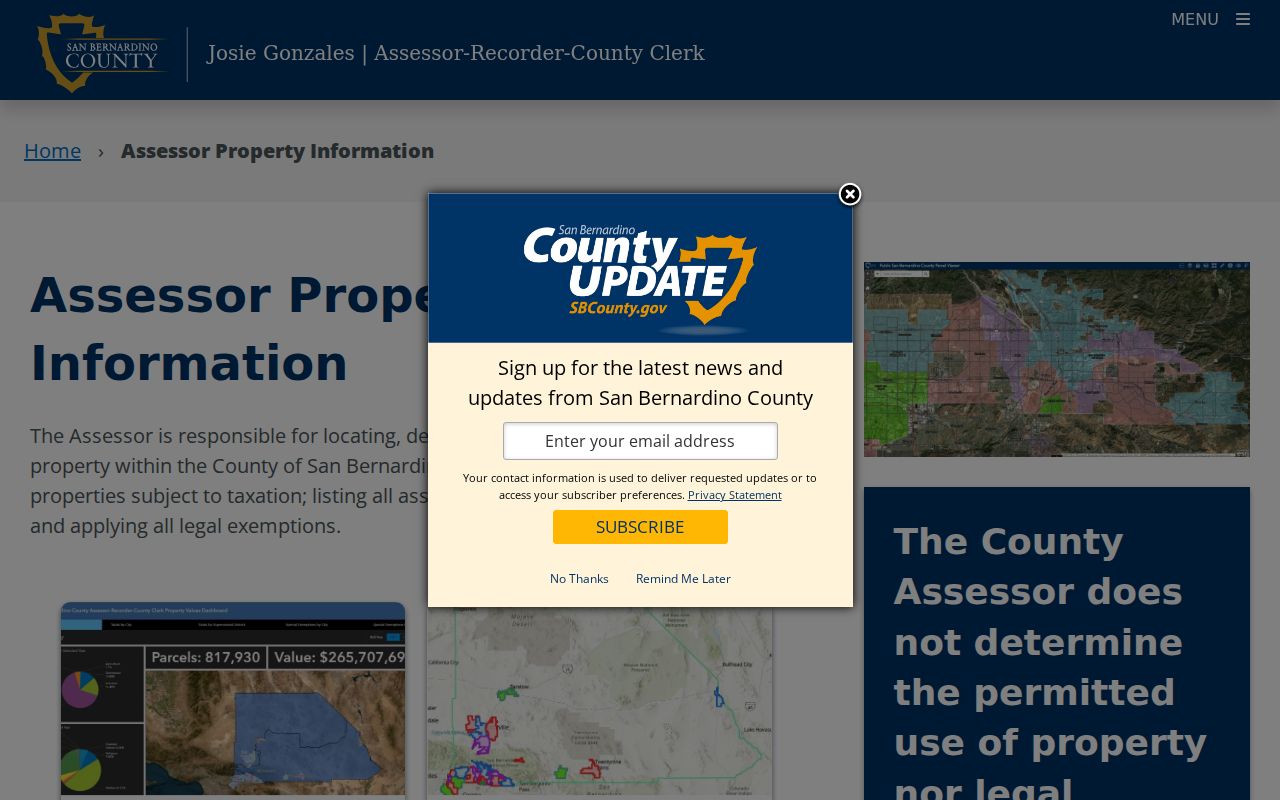
The assessor image shows the county-level starting point for an address trail. Move from its map and property facts to the recorder only after the parcel and owner are clear.
Reading Yucaipa's 1925 Recorder Index
San Bernardino County's online Recorder's Index reaches from 1925 to the present, but it is an index rather than a digital deed book. Search fields include grantor or grantee, document number, document date or range, and document title or type. Deeds, deeds of trust, liens, releases, reconveyances, maps, and other recorded instruments can appear as indexed titles. Search both sides of a transfer. Trust names, initials, married names, and spelling variants can change the path.
A typical result identifies party names and roles, document number, recording date, and document title. It supplies the locator for an order or counter visit. The online result does not show the full instrument, consideration, signatures, or legal description. Images can be viewed at the Hall of Records or High Desert Government Center, or ordered. The county says mail requests usually return in one to two weeks. Online orders add a card surcharge, while the July 1, 2026 schedule lists $4 for the first page and $1.50 for each later page, with separate mail and certificate charges.
The ARC Official Records page explains the index and the route to an official copy.
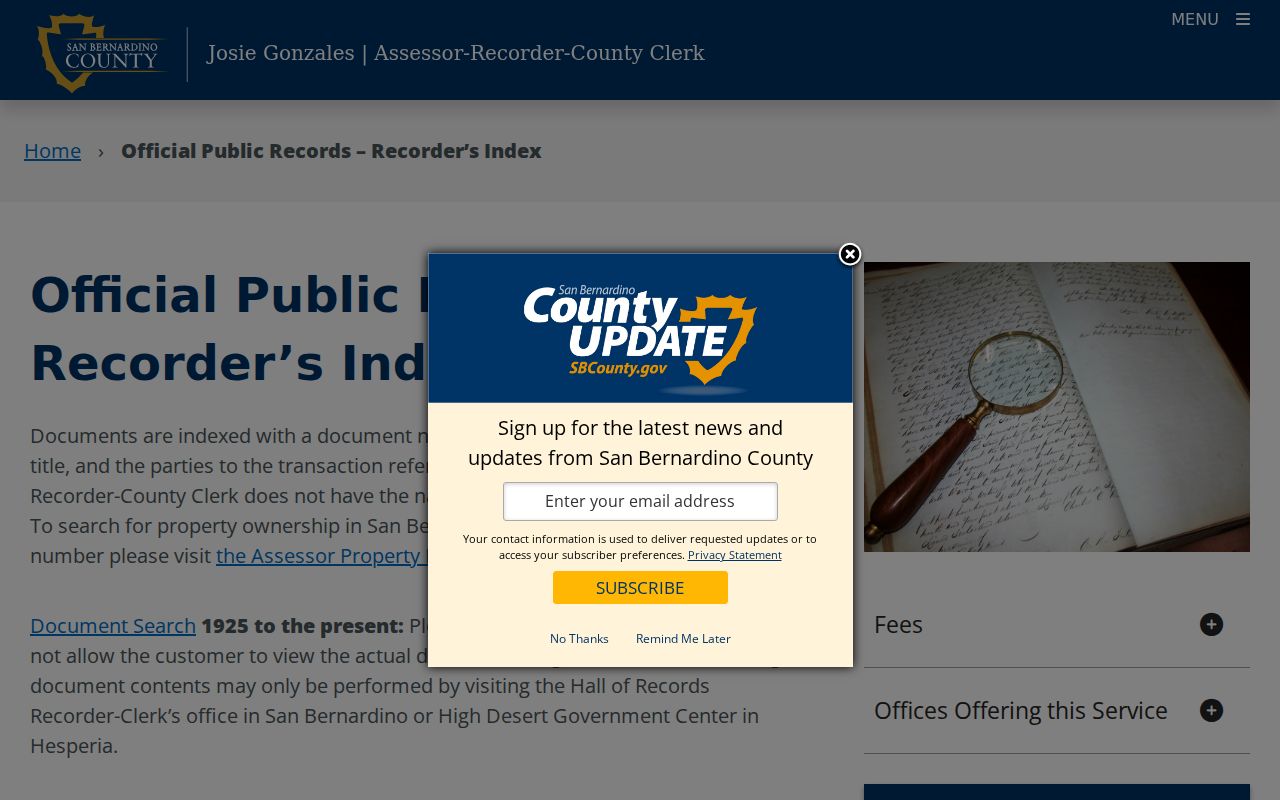
The recorder image represents the free locator layer. For house history or ownership proof, the ordered or in-person instrument is the part that supplies the legal description.
Index versus instrument. A Yucaipa search result can point to the right document without proving that the document says what a name-only reading suggests. Match the APN, lot, block, tract, parties, and date before relying on it.
Current Yucaipa Resident Directory Sources
There is no single current Yucaipa resident roll. Instead, several sources expose a narrow slice of the local population or a particular relationship to a place. The property roll is owner-centered. The voter tool is self-authenticated. The recorder is transaction-centered. City files show participation in a public project, permit, meeting, or filing. Association rosters, utility data, and household details are not public substitutes for those records.
| Source | Who or what appears | Keeper | Access |
|---|---|---|---|
| Parcel and assessment roll | Current roll owner, parcel facts, possible mailing destination | County Assessor | Free map and public property tools |
| Official Records Index | Grantors, grantees, liens, releases, and recorded map references | County Recorder | Free index; image by order or counter visit |
| City Records Center | Applicants, speakers, officials, project parties, and public filings | City of Yucaipa | Online search or CPRA request |
| Voter status | An authenticated voter's registration and election details | California Secretary of State | Self-only tool; restricted file rules |
| Historical directory shelf | Adults, households, occupations, and addresses in a dated volume | NARA, libraries, and archives | Catalog, library, or in-person access |
Choose the source by question. An APN answers where land sits. A recorded deed answers who signed a transfer. A city agenda may identify a speaker or applicant. A directory places a person in a historical snapshot. When the question shifts from a local roll to one person, keep the name, role, and date tied together.
Yucaipa Court Cases Without Namesake Errors
Yucaipa cases are held by the San Bernardino Superior Court, not ARC. The Court Access Portal, or CAP, covers permitted civil, criminal and traffic, family, and probate case information. Its search can use a full case number, first name, middle name, last name or business name, case type, division, filing date, and calendar controls. A case result may show the case number, title, parties and roles, filing date, location, register of actions, hearings, disposition, and document links that qualify for remote viewing or purchase.
CAP is a public case-information system, not the official court file. California Rule of Court 2.503 limits remote access to sensitive criminal, family, juvenile, guardianship, mental-health, and protected-victim material. Older case data can be thin before 1998. A courthouse terminal or the branch holding the file may offer an access route that the remote portal does not. A name hit alone is never enough. Compare role, filing location, date, middle name, related parties, and the kind of case.
The San Bernardino Court Access Portal is the official remote starting point.
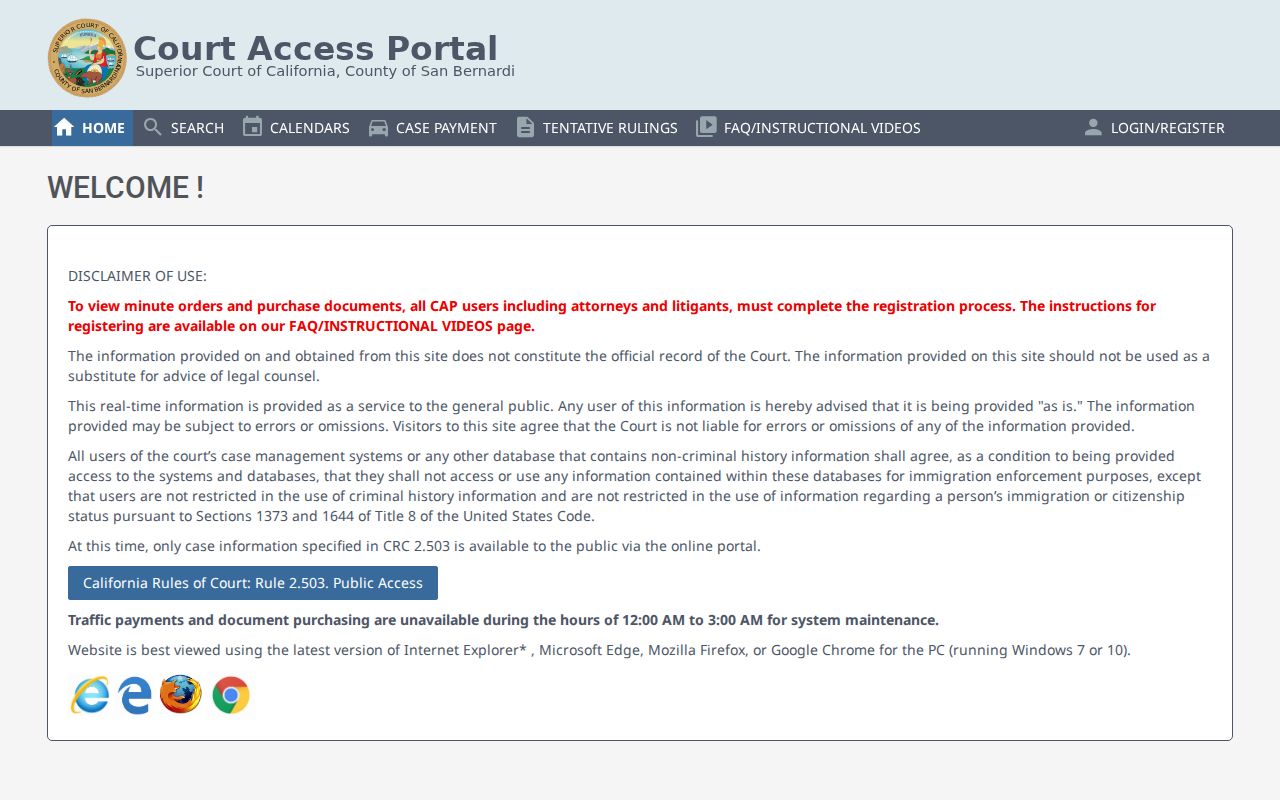
The court image illustrates the difference between a searchable index and a complete file. A clerk or court request is the next step when a docket entry needs context.
California Voter Status for a Yucaipa Search
California My Voter Status is not a public people directory. It requires the user's first name, last name, date of birth, and one identity route using a California driver's license or ID number, or the last four digits of a Social Security number. The authenticated voter may see registration location, party preference, language choice, ballot status, polling place, election information, and county contact details. A new online registration may need at least 24 hours before it appears.
California Elections Code section 2194 controls disclosure of voter affidavit information. Approved election, scholarly, journalistic, political, and governmental purposes are distinct from ordinary personal browsing. Government Code section 7924.000 protects home street address, phone, email, precinct and prior-registration information, signature, license or ID details, and other identifiers. The county does publish weekly registration counts and precinct context, which can describe a community without creating a street-level list.
The California My Voter Status portal shows the personal authentication step.
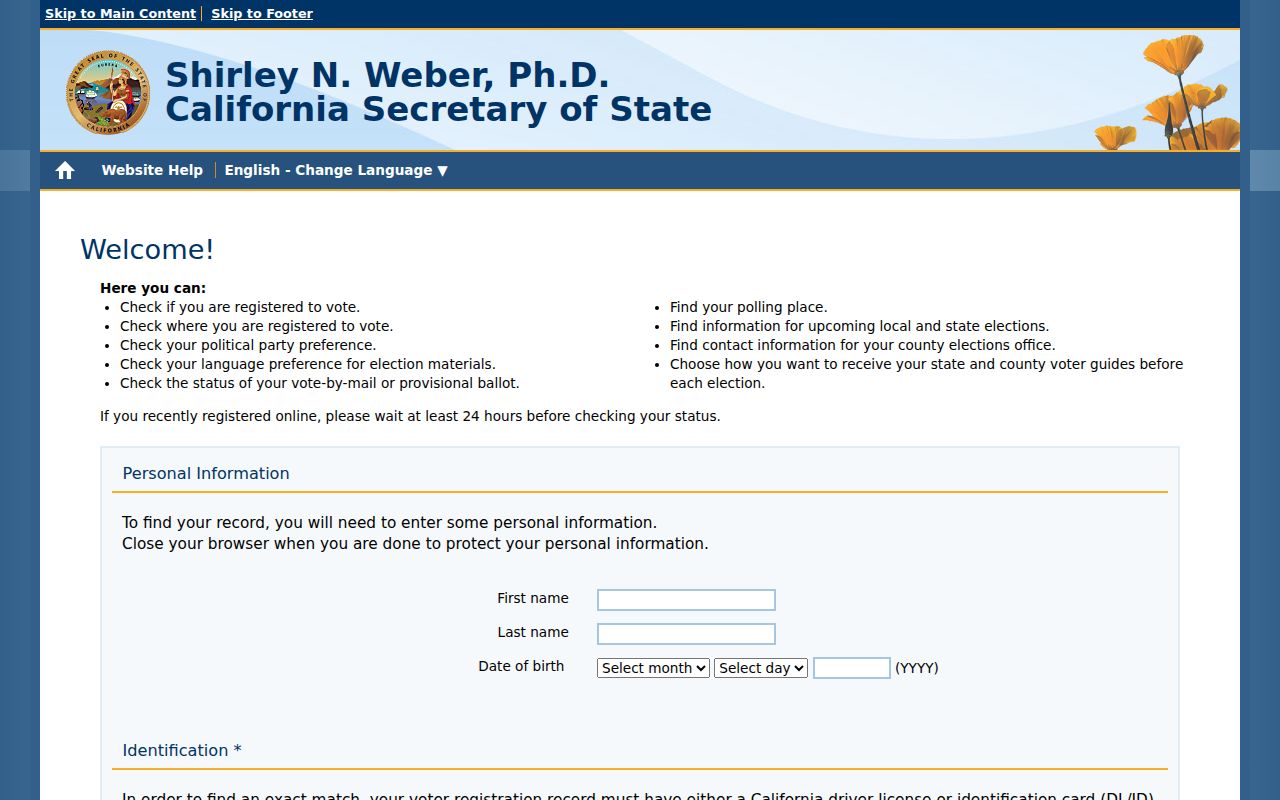
The voter image is a reminder that an exact-match self-service tool answers the account holder's question, not a neighbor lookup.
Yucaipa Vital Records: Two Copy Types
California vital records do not follow a simple rule that makes every birth or death public after a fixed number of years. The operational split is between an authorized certified copy for an eligible requester and an informational certified copy marked as not valid to establish identity. Health and Safety Code sections 103525, 103526, and 103550 shape that process. Confidential marriage records remain limited under Family Code section 511, and adoption files are sealed under Family Code sections 9200 through 9203 unless a lawful access route applies.
For a Yucaipa event, San Bernardino County ARC handles county birth and death records and marriage licenses purchased in the county. CDPH is the statewide custodian. The county application asks for the record type, names, event date and place, parent or spouse information, requester relationship, purpose, copy type, and identity or notary details. The 2026 county schedule lists $34 for a birth record, $26 for a death record, and $19 for a marriage record. The state schedule lists $31, $26, and $19 respectively. A certification of search may issue when no record is found.
The county vital-records page is the best source for the current application path.
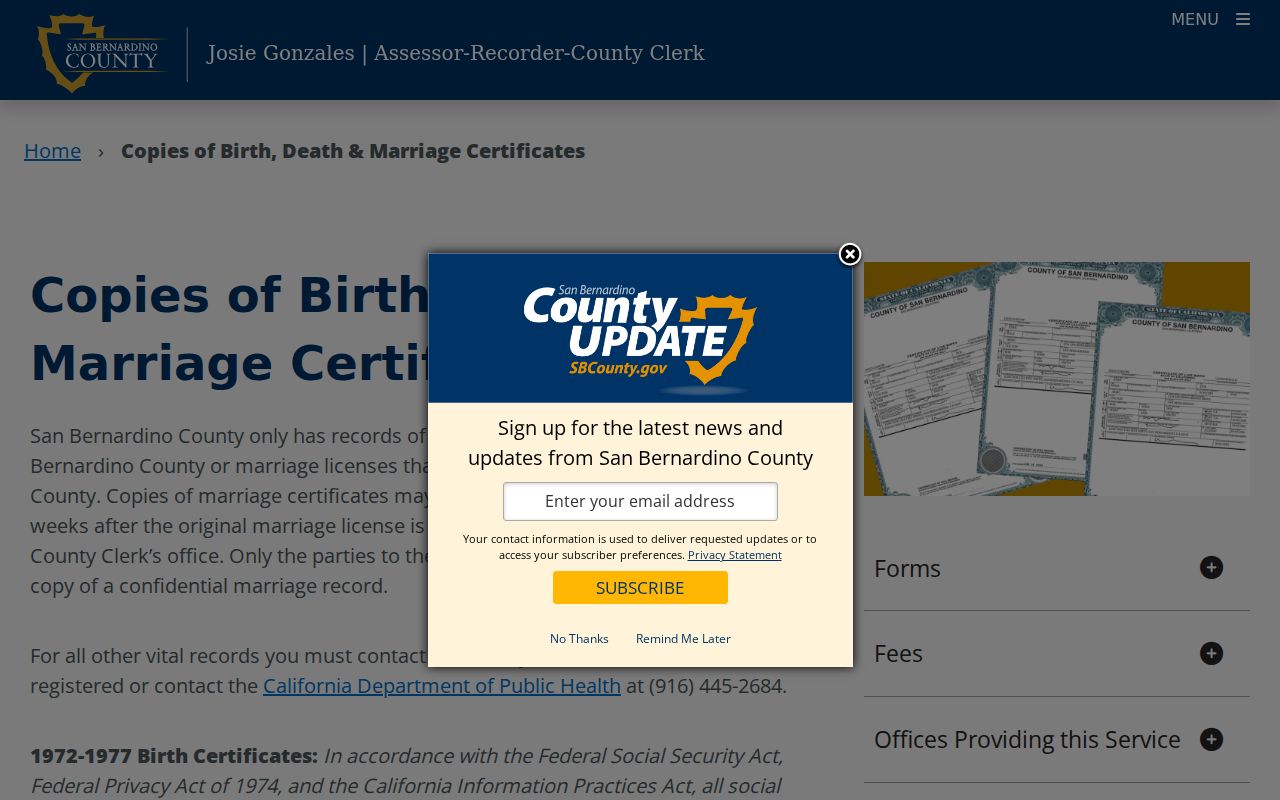
The vital-record image points to the custodian and application process, not to an open name index. Historical indexes can help locate an event, but the official copy remains subject to eligibility.
Research myth. Treat the authorized-versus-informational distinction as the first question. A public genealogy lead does not automatically grant access to a certified identity document.
Yucaipa Business and License Trails
A business connection can help identify a person, but it is a role clue rather than proof of residence. Start with the city Permit Exchange or business-license material for a project address. Search the county's fictitious business name records for the registrant behind a trade name. Then search California Secretary of State bizfile for the legal entity, status, agent, filed addresses, and officer or manager names. An agent for service is a legal contact role and may not own or live at the address.
Professional records add a separate check. The Department of Consumer Affairs search covers many boards, while contractors, real-estate licensees, attorneys, educators, and other fields have their own systems. License results can show status, expiration, discipline, city, or business affiliation. Use the correct board and preserve the result date. A permit applicant or contractor identifies participation in a project, not a household.
| Layer | Useful identity clue | What it cannot establish |
|---|---|---|
| Yucaipa Permit Exchange | Project address, permit or code case, named applicant when public | That an applicant is a resident |
| County fictitious business name | Registrant connected to a local trade name | Current license or current residence |
| SOS bizfile | Entity status, agent, officers or managers in filed records | That a mailing address is a home |
| DCA or CSLB | License status, classification, and public discipline information | That a licensee lives at a project address |
Yucaipa Requests When Portals Stop
The California Public Records Act, Government Code sections 7920.000 through 7931.000, lets any person request identifiable state or local agency records. A useful request names the department, record series, address or APN, date range, and preferred electronic format. The law does not require an agency to create a new list or answer a broad research question. Agencies ordinarily make a disclosability determination within ten days, with a possible fourteen-day extension for unusual circumstances. That is a decision window, not a promise that production will be complete.
For Yucaipa city material, the Records Center provides a request, answers, archive, and trending-topics path. Ask for an existing permit jacket, map, plan, agenda, agreement, or public filing. For a deed image, contact ARC. For a court file, contact the filing branch. For voter data, use the county application and state an approved purpose. Narrow wording helps the custodian locate an actual record and makes privacy review clearer.
Yucaipa's GovQA public-record portal displays the local request and archive entry points.
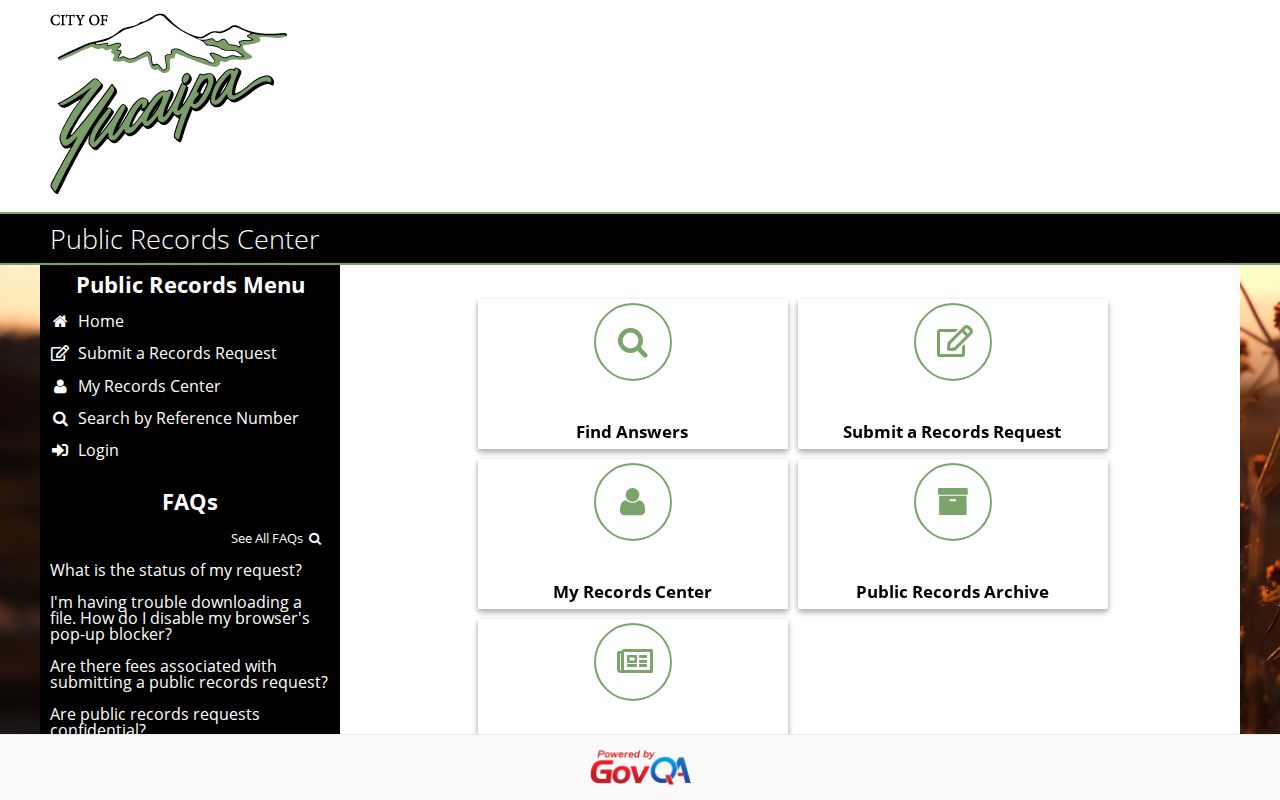
The city portal image is a useful fallback when a named city record is not in a public search result. It does not turn City Hall into a county deed or court-record custodian.
Historical Yucaipa Resident Directories
The strongest historical directory lead uses a regional title. NARA's circa-1930 inventory says San Bernardino directories include Mentone, Crafton, Loma Linda, Bryn Mawr, and Yucaipa Valley in 1927, 1929, 1931, and 1933. A title-only search for a standalone Yucaipa book can therefore miss the relevant shelf. The California State Library holds a broader city and county directory collection, while the Yucaipa Branch can check local telephone books, reverse directories, yearbooks, newspapers, and databases. Exact branch years were not published in a stable online finding.
A directory year can place an adult or household at an address and may add an occupation, spouse, telephone, or residence mark. It is a dated snapshot. Pair 1929 or 1931 with the 1930 census, then compare the household, occupation, and locality. The Yucaipa Valley Historical Society and Mousley Museum can add photographs, oral histories, ranch or tract material, and local context by appointment. The full shelf and reading method belong on the Yucaipa city directory collections page.
Local catalog clue. Search Yucaipa Valley together with San Bernardino, Crafton, and Mentone when a directory title does not use the modern city name.
Yucaipa Houses and Heir Research
For a deceased owner, a deed trail and probate file can answer different parts of the same question. The recorder can show a grantor, grantee, transfer date, and legal description. Superior Court probate material may show a decedent, petitioner, heirs, notices, and estate addresses, subject to access limits and redaction. A later deed should be matched to the same APN or legal description before it is treated as a continuation. Obituaries and cemetery records are finding aids, not substitutes for a certificate or court file.
Begin with the current parcel and work backward through recorded transfers. If the person is deceased, search an exact name with Yucaipa in newspapers and then verify the event. The California Controller's unclaimed-property search can provide an old city or address clue, but a result is not current residence evidence. These sources are useful for family history, estate questions, and reconnecting relatives when handled with care.
Do not infer a living household from an old deed, an obituary, or a business filing. Date each clue, preserve the source role, and stop when the next step would require protected information.
Protecting Yucaipa Resident Data
California privacy rules affect different sources in different ways. Safe at Home can provide eligible survivors, victims, and specified threatened workers with a substitute mailing address. Government Code sections 6205 through 6211, including section 6208.1, limit harmful public display after a written demand. A missing or alternate address can reflect protection, not an error. Voter fields are separately restricted, and DMV information is controlled by the federal Driver's Privacy Protection Act.
Correct the source that holds the record. Ask the assessor about an assessment item, the recorder about an index or copy, the court about a docket, the Registrar of Voters about registration, CDPH or ARC about a vital certificate, and the licensing board about a license. California's CCPA rights and the 2026 Delete Request and Opt-out Platform affect covered commercial data brokers, not lawful deeds, court dockets, or government records. A compilation service cannot rewrite a government source.
A Yucaipa residents directory is most useful when every name remains attached to a source, date, and role. Use public records for lawful personal research, family history, civic understanding, and scam avoidance. Do not use an address trail to stalk, harass, threaten, or harm anyone.